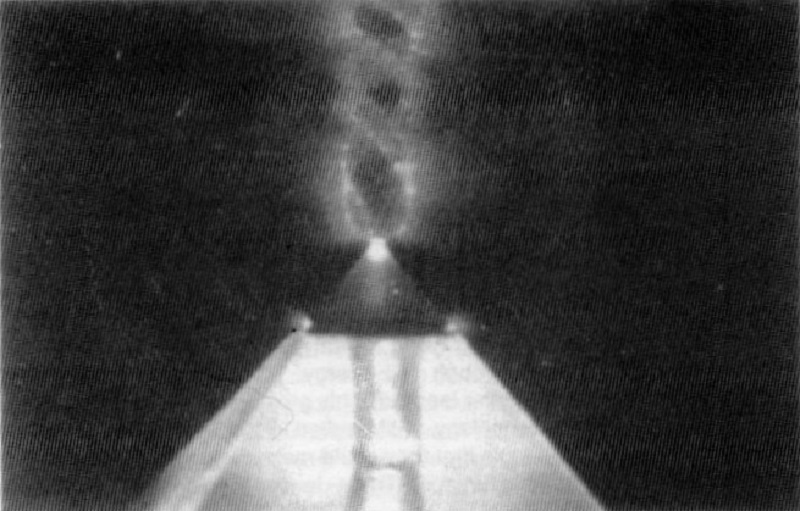

"The Great Pyramid was able to concentrate electromagnetic energy inside its chambers but also well beneath its base, where an unfinished chamber is located."
The Great Pyramid of Giza, built for the Fourth Dynasty pharaoh Khufu, has been studied for centuries as an engineering feat and as a key monument in Egypt’s Old Kingdom funerary landscape. It has also become a magnet for modern claims that the structure was designed for purposes beyond royal burial.
A peer-reviewed physics study added a narrower, more testable claim to that mix: under certain conditions, the pyramid’s geometry can cause incoming electromagnetic waves to concentrate energy in specific interior spaces. The work, published in the Journal of Applied Physics, did not argue that ancient Egyptians understood radio waves or built the monument to harness them. It treated the pyramid as a physical object with a distinctive shape, then asked how that shape would interact with radio-frequency fields.
A monument with unusually stable dimensions
The Great Pyramid once stood about 146.6 meters tall and remained the world’s tallest human-made structure for many centuries. It sits on the Giza Plateau outside Cairo as part of a larger complex of pyramids and temples that UNESCO lists as “Memphis and its Necropolis – the Pyramid Fields from Giza to Dahshur.” The core is largely limestone, with granite used in key interior elements, including the King’s Chamber.
Traditional archaeological interpretation holds that the pyramid was built as Khufu’s tomb within a broader system of mortuary architecture and ritual. At the same time, the pyramid’s interior has long fueled debate because no mummy has been found inside it, and because the main chambers are largely undecorated compared with later royal tombs. That tension, between a widely accepted funerary framework and a sparse interior record, is part of what keeps the structure in the crosshairs of alternative theories.
The physics study did not try to resolve that historical argument. It focused on what happens when electromagnetic waves encounter a large, sharply angled stone structure.
The 2018 simulations and what they tested
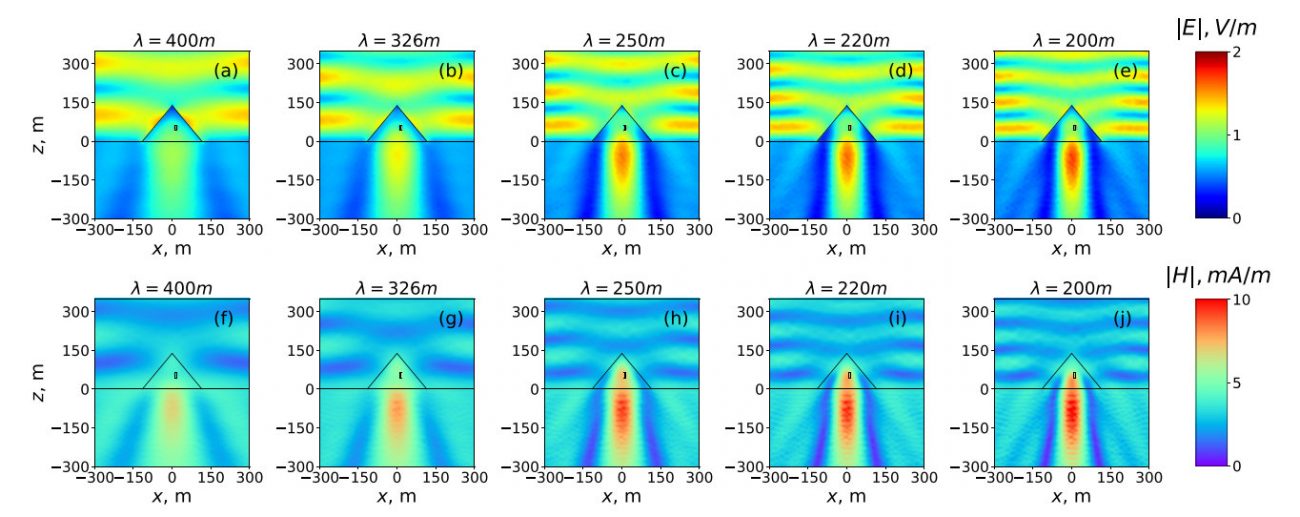
In the Journal of Applied Physics paper, researchers modeled the pyramid’s electromagnetic response in the radio-wave range. The work is associated with scientists at ITMO University and Laser Zentrum Hannover, and it relied on numerical simulations and analytical methods used in electromagnetic scattering problems.
The basic idea is familiar in physics: when the size of an object and the wavelength of incoming radiation line up in certain ways, the interaction can enter a “resonant” regime. In resonance, fields can become stronger in particular regions, even if the object is passive. In the pyramid case, the team reported that, under resonance conditions, the modeled electromagnetic field tended to concentrate in the King’s and Queen’s chambers and in the region beneath the pyramid’s base.
To quantify how strongly the pyramid would interact with incoming waves, the researchers used a measure known as an “extinction cross-section,” which captures how much electromagnetic energy is removed from a wave through scattering and absorption. In their results, the scattering pattern did not spread evenly. Instead, certain volumes inside the structure emerged as hotspots for field concentration in the resonant state.
Dr. Andrey Evlyukhin, a co-author of the study, described the framing in plain terms. “Egyptian pyramids have always attracted great attention,” he said. “As scientists, we were interested in them as physical objects. We treated the Great Pyramid as a particle dissipating radio waves.”
What the models assumed
The researchers emphasized constraints that are easy to lose in popular retellings. They simplified the pyramid into a homogeneous material, effectively treating it as uniformly limestone in the calculations. They did not build in hidden rooms, unknown metals, or any speculative technology. The goal was to isolate geometry and scale as the drivers of the effect.
Those assumptions matter because they limit what the results can be used to claim. The study demonstrates that a pyramid-like structure of the Great Pyramid’s dimensions can, in theory, produce localized electromagnetic field concentration at particular radio wavelengths. It does not demonstrate that the real pyramid behaves exactly that way in the field, where material layers, cracks, voids, and the complex geology under the monument could change the details. It also does not imply any intentional design for electromagnetic performance.
The work sits in a broader scientific pattern: researchers routinely use idealized models to identify whether a phenomenon is plausible and where it would show up most strongly. The next step, if one were pursued, would be measurement campaigns designed around the predicted frequencies and locations. The 2018 paper itself positioned the result as a bridge toward engineered structures, not a historical argument about ancient knowledge.
What it does not prove about ancient intent
Because the mechanism depends on matching a wavelength to an object’s dimensions, the effect belongs to modern electromagnetic theory. There is no evidence from Khufu’s reign that builders had a concept of radio waves or resonance in the physics sense. No surviving Old Kingdom texts describe anything like that, and the study did not claim otherwise.
Still, the result is easy to misread because it attaches a modern term, “electromagnetic energy,” to an ancient icon. The cleanest way to interpret the finding is as an architectural byproduct: a large, sharply defined shape can interact with long-wavelength radiation in ways that concentrate fields in particular interior volumes. Under that reading, the pyramid is not a machine. It is a structure that can, at certain frequencies, behave like a resonator.
That distinction is also why the study can be simultaneously intriguing and limited. It is intriguing because it identifies a specific, testable behavior tied to the pyramid’s geometry. It is limited because it cannot, on its own, tell historians why the pyramid was built or what its builders understood about the natural world.
A continuing effort to map the interior without excavation
The electromagnetic modeling arrived amid renewed interest in noninvasive methods for studying the Great Pyramid’s interior structure. In 2017, an international team using cosmic-ray muon radiography reported evidence for a previously unknown large void above the Grand Gallery in a paper in Nature. The muon result, like the electromagnetic study, did not assign a purpose to what was detected. It offered a measurement-based constraint on what exists inside the stone.
Together, these lines of research point in the same direction: the Great Pyramid remains a scientific object as well as a historical one, and modern instruments can still extract new information from it without drilling or dismantling.
The electromagnetic study does not settle arguments about the pyramid’s function. It does not validate claims of lost technology. What it does add is a rigorously framed claim about how a structure of this scale can shape radio-frequency fields under resonance conditions, and it does so in a way that can be checked, challenged, or refined by further modeling and measurement