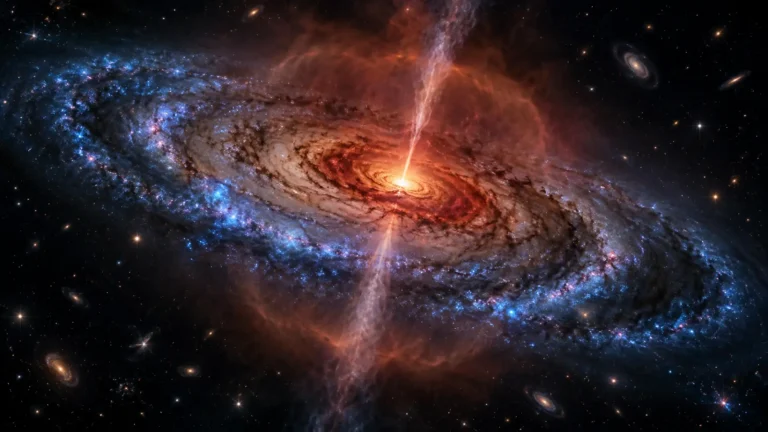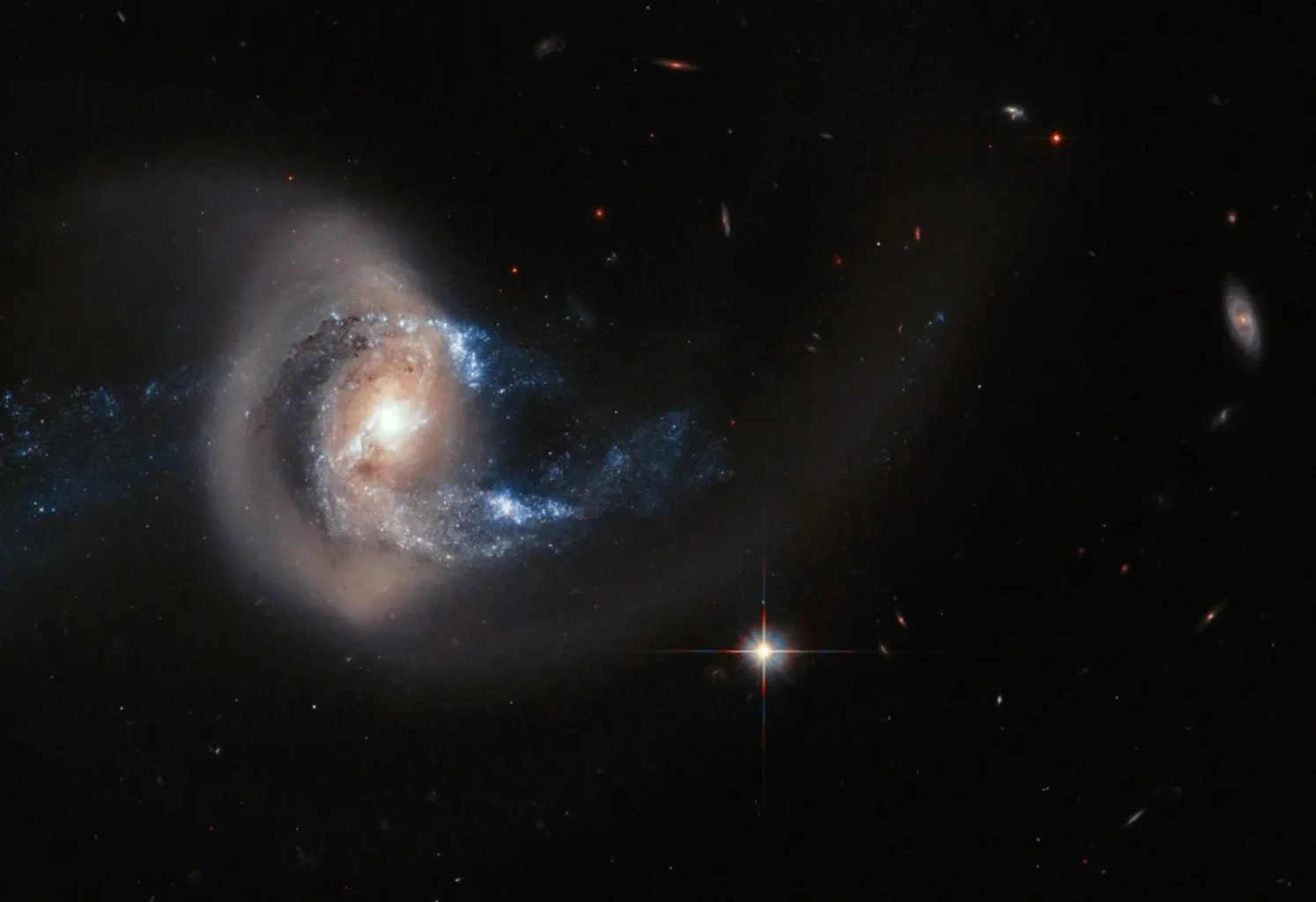
How do telescopes measure the motion of distant galaxies? They read the fingerprints of atoms in the light those galaxies emit. A photograph can show a spiral, a cluster or a faint smudge, but a spectrum spreads the light into its component wavelengths. Small shifts in familiar lines reveal whether the source is moving toward us or away. The redshift method also depends on reliable distances; our guide to the cosmic distance ladder explains that next step.
The method begins with atoms. Hydrogen, oxygen, calcium and other elements absorb or emit light at particular wavelengths. Those lines are the same wherever the atoms are found. If a galaxy is moving, the lines arrive at slightly different positions than they would in a laboratory. The shift is small, but it can be measured with a spectrograph attached to a telescope.
Redshift is a change in wavelength
When a source moves away, its light is stretched toward longer, redder wavelengths. This is redshift. When a source approaches, the wavelengths are compressed toward blue. The effect is related to the Doppler shift familiar from a train whistle, although distant galaxies also carry the imprint of the expanding universe itself.
For nearby objects, the shift mainly records local motion. A galaxy may be orbiting within a group, falling toward a cluster or being pushed by the gravitational pull of a larger structure. Astronomers can measure that motion by comparing the observed position of a spectral line with its laboratory wavelength.
The expanding universe changes the interpretation
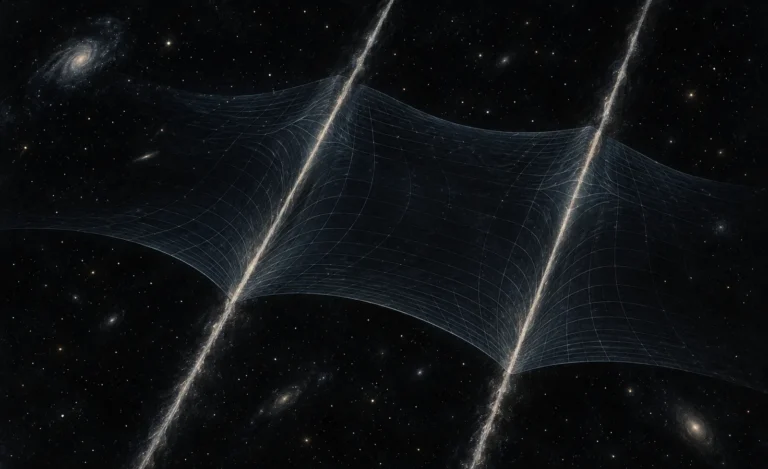
At larger distances, space itself is expanding while the light travels. The wavelengths are stretched along the journey, so a galaxy’s redshift reflects the history of the universe as well as the galaxy’s local movement. In a simplified picture, the greater the redshift, the farther away the galaxy is and the faster the space between us and it has grown.
That relationship is not a simple speedometer. Astronomers combine redshift with distance measurements from standard candles, galaxy patterns and other indicators. A galaxy can have a local motion that makes it appear slightly closer or farther than a basic redshift estimate suggests. On the scale of a cluster, those differences reveal the gravitational field and the way matter is arranged.
Why the lines are better than colour alone
A galaxy’s colour can be affected by its stars, dust and the age of its stellar population. A spectrum contains more information. It can show emission from gas around young stars, absorption by older stars, the presence of active black holes and the chemical ingredients of the galaxy. The positions of the lines measure motion; their strength and shape tell astronomers what is happening inside the system.
Modern surveys collect spectra from thousands or millions of galaxies. The telescope does not need to watch a galaxy travel across the sky. The motion is encoded in light that has already crossed the distance. This is why an apparently motionless image can still contain a record of a galaxy’s velocity.
Radial motion is only one part of the picture
Redshift mainly measures motion along our line of sight. A galaxy can also drift sideways across the sky, a movement called proper motion. For distant galaxies that sideways shift is too small to measure directly, but nearby stars and galaxies can reveal it with repeated observations. Combining the two components gives a fuller picture of how a system moves.
Inside a galaxy cluster, the spread of velocities is useful in its own right. Galaxies moving rapidly in different directions can remain bound only if the cluster contains enough mass. Comparing those motions with the visible stars and gas helped establish that much of a cluster’s mass is dark matter rather than ordinary material.
Motion maps the architecture of the cosmos
When astronomers combine redshifts across a large survey, they can build a three-dimensional map of the universe. Clusters, filaments and broad empty regions appear through the way galaxies are distributed in space. The motions within those structures show how gravity has gathered matter over cosmic time.
Our own Milky Way is part of a large region called Laniakea, and its motion is affected by the uneven distribution of galaxies and mass around us. Redshift does not reveal a single hidden centre or an arrow pointing to one cosmic destination. It gives researchers thousands of measurements with which to reconstruct how the universe is organised.
The next time a telescope image shows a distant galaxy as a quiet pinwheel, remember that the real measurement may be hiding in the colours. The spectrum turns light into motion, and motion into a map of the expanding cosmos.
Those maps give a larger setting for the Laniakea supercluster and the gravitational region called the Great Attractor. Neither is found by looking for a single picture; both are inferred from many measurements of distance and motion.
Sources and further reading: NASA: How to Measure the Universe; NASA Science: The Universe.