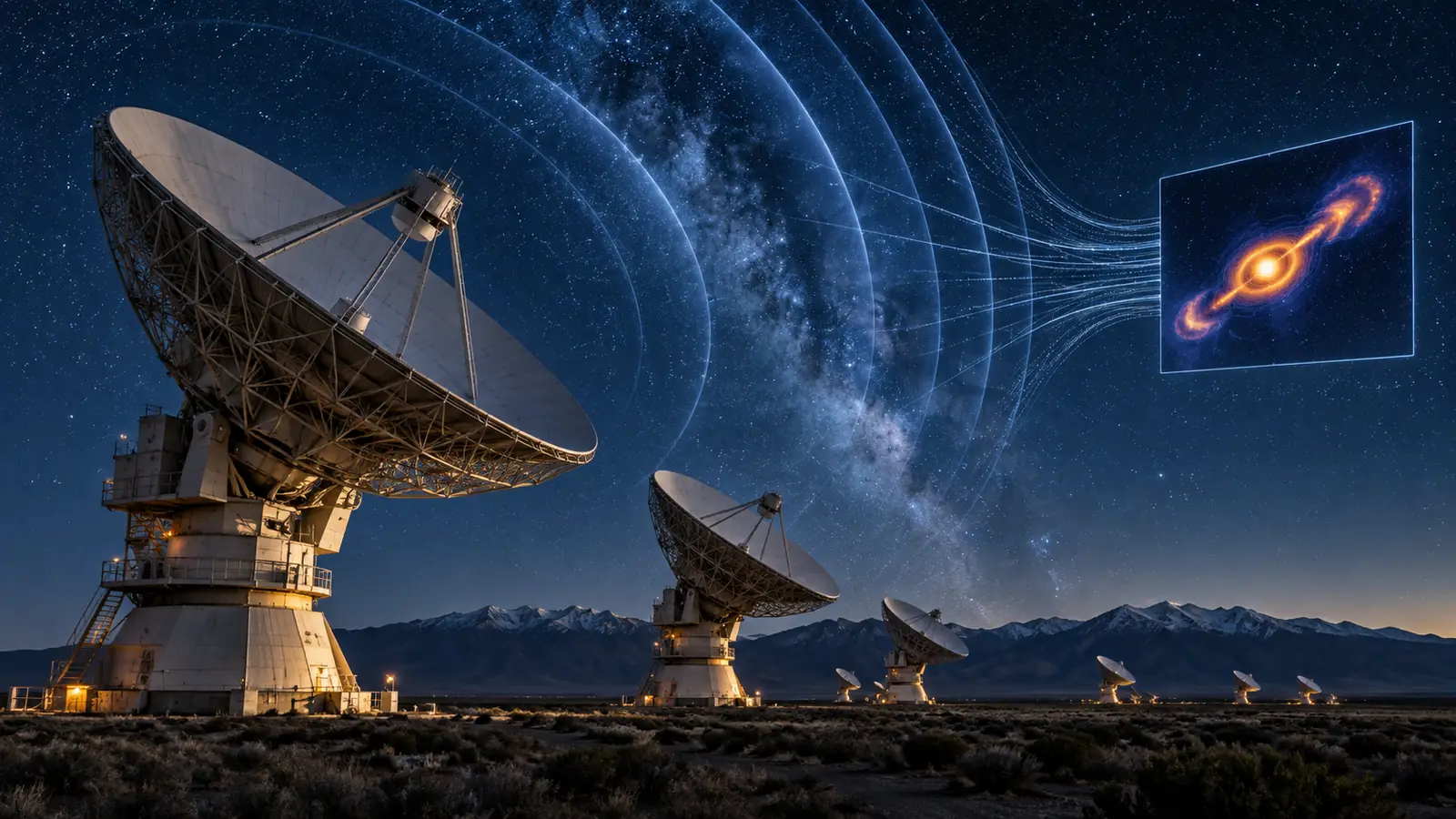
A visible-light photograph shows only one part of the universe. Stars, planets and glowing clouds can look familiar in those wavelengths, while the same objects may appear completely different in radio waves.
Radio telescopes are designed to collect that longer-wavelength radiation. Their dishes are reflective surfaces, much like mirrors are for visible light, but the instruments behind them measure electrical signals instead of recording a picture with a camera. The result is not an image that exists before the observation. It is an image reconstructed from measurements.
That difference explains why a radio map can reveal cold gas, magnetic fields, energetic jets and regions hidden behind dust. It also explains why the finished image depends on the telescope, the observing frequency and the way the data are processed.
Keep exploring
Continue with Curiosmos
What does a single dish actually measure?
A radio dish focuses incoming waves onto a receiver at its focal point. The receiver measures how much radio energy arrives over time and across a selected range of frequencies. As the dish points at different positions on the sky, the telescope builds a set of measurements that can be turned into a map.
The simplest version is similar to scanning a landscape with a very sensitive microphone. Each pointing records the strength of the signal from that part of the sky. A computer then combines the measurements into a grid showing where the radio emission is strongest and how it changes across the field.
The map is not a photograph in the ordinary sense. Bright and dark regions represent measured radio intensity, often displayed in colours chosen by the researchers. A colour on the final image is a visual code for a value in the data; it is not the literal colour an observer would see.
Why are radio dishes so large?
Radio waves are much longer than visible-light waves. To distinguish two nearby sources, a telescope needs a collecting surface and an effective aperture large enough to resolve their separation. Building a single dish with the required diameter quickly becomes expensive and mechanically difficult.
One solution is to connect many antennas. An array can behave like a much larger telescope because the signals from its antennas are recorded together and compared. The separation between antennas helps determine the sharpness of the resulting image, while the total collecting area affects sensitivity.
The National Radio Astronomy Observatory describes this technique as interferometry. Antennas placed farther apart generally produce finer detail; antennas arranged more closely can improve sensitivity to larger, fainter structures. There is no single arrangement that is best for every scientific question.
How can separate antennas act like one instrument?
Radio waves from the same celestial source reach each antenna at slightly different times. A correlator aligns the signals and compares their phases. Those comparisons preserve information about the direction and structure of the incoming wavefront.
The array does not simply add the signals together like separate audio recordings. It samples the wave pattern from many different antenna pairs. As Earth rotates, the geometry between the array and the source changes, giving the observation additional samples of the sky.
Software uses those samples to construct an image. In simplified terms, the measurement describes how much structure exists at different spatial scales, and mathematical reconstruction turns those measurements into a map. The raw result is not perfect: calibration, incomplete sampling and interference from human technology must all be addressed.
Why do radio images need calibration?
A radio observatory measures the sky through an instrument with its own response. Receivers have noise. Antennas have different sensitivities. Atmospheric conditions can affect some frequencies, and satellites, mobile networks or other transmitters can contaminate the data.
Astronomers observe calibration sources with known properties to estimate how the instrument behaved during the session. They can then correct the science data before making the image. If the calibration is poor, a bright streak or false feature can appear in the map.
The imaging stage also involves choices. Weighting some measurements more heavily can sharpen a compact source or preserve broad emission. Algorithms used to remove the effect of the telescope’s response can make faint structures easier to see, but they must be checked against the original measurements. A dramatic image still needs a transparent path back to the data.
What can radio astronomy reveal?
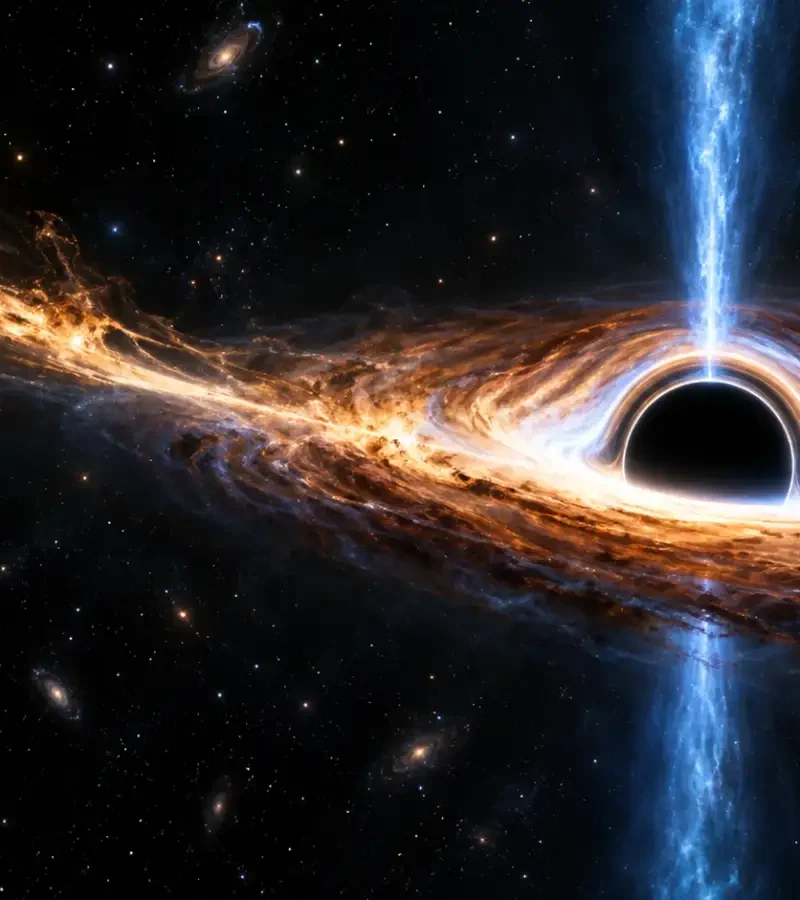
Radio observations can trace hydrogen gas, molecules in star-forming regions and the jets launched by active black holes. They can also show synchrotron emission from fast-moving charged particles and reveal magnetic fields through the way radio waves are polarized. For a broader guide to the structures these observations help map, see our explainer on what a galaxy is.
Because radio waves can pass through clouds of dust that block visible light, a radio map may expose structures that an optical image hides. The two views are complementary. A bright optical nebula and a bright radio source may trace different physical processes inside the same region.
Frequency matters as well. Different radio bands can respond to different molecules, temperatures or particle populations. A single object can therefore produce a set of radio images that tell different parts of its story.
When is a radio image a strong result?
The strongest interpretation connects the image to the observing setup and to independent evidence. Researchers can compare a radio structure with optical, infrared or X-ray observations; test whether it appears at more than one frequency; and check whether its shape survives reasonable changes in calibration and imaging.
That discipline matters because reconstruction is powerful. The computer can make an invisible sky legible, but it cannot recover information that the antennas never measured. A gap in the data can leave gaps in the image, and processing choices can change what stands out.
Radio telescopes are therefore best understood as instruments that translate waves into evidence. They do not simply take pictures of a hidden universe. They measure, compare and reconstruct it—and every finished image carries the history of how those steps were done.