A promising signal is not the same as a discovery
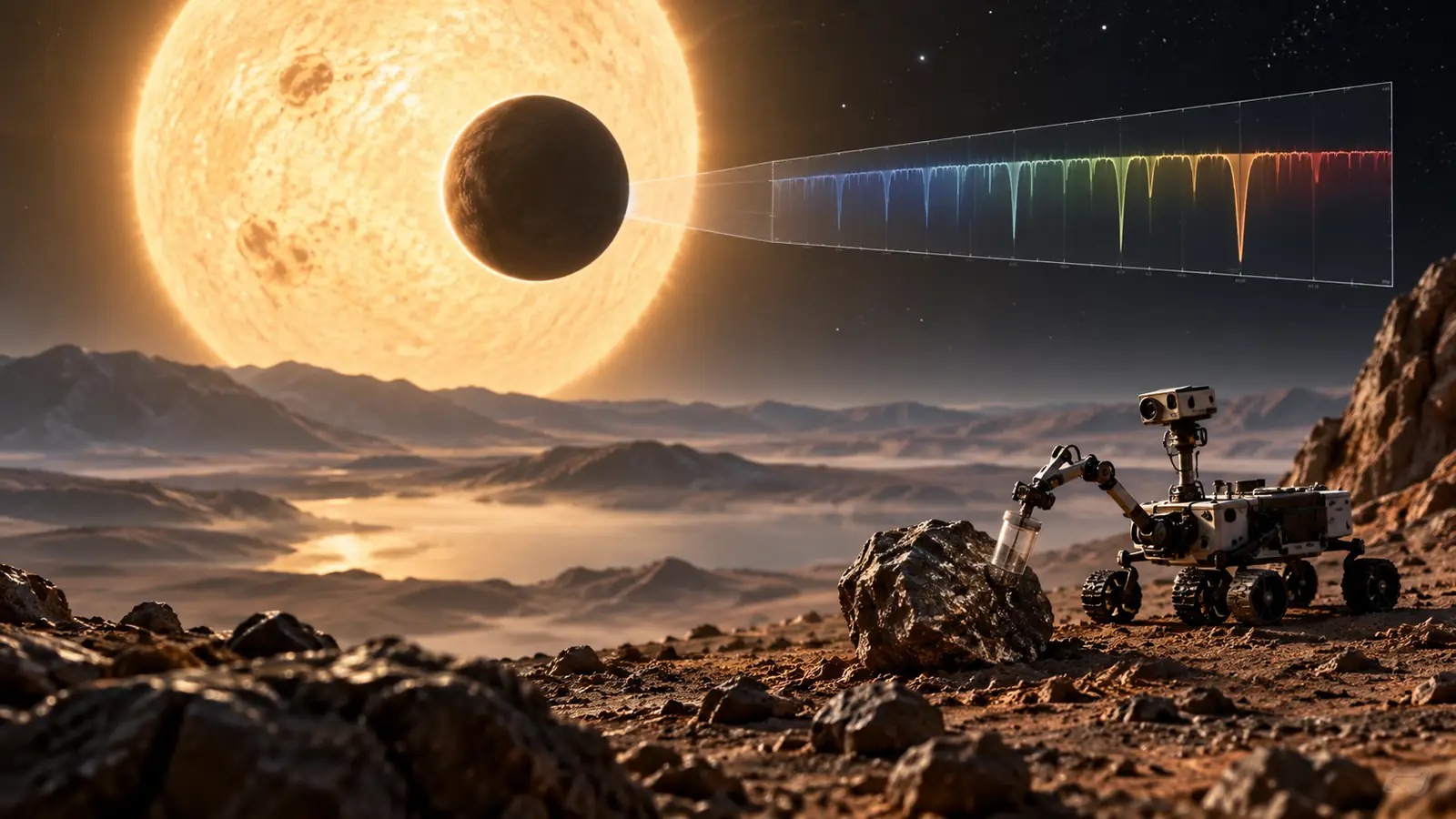
Imagine a telescope finding an unusual gas in the atmosphere of a distant planet. Or a rover drilling into an ancient Martian rock and finding complex organic molecules. The first reaction would be understandable: have we found life?
Astrobiology begins with a more careful question. What evidence would separate biology from chemistry that only resembles biology?
NASA defines a biosignature as a characteristic, element, molecule, substance or feature that can provide evidence for past or present life. The word “evidence” matters. A biosignature is a clue that must be interpreted in context, tested against non-biological explanations and, ideally, confirmed by independent measurements.
Keep exploring
Continue with Curiosmos
Habitability is the beginning of the search
Scientists often begin by asking whether an environment could support life. That might mean liquid water, useful chemistry, an energy source and conditions that remain stable long enough for biological processes to operate.
A habitable environment is not automatically inhabited. Earth contains places where life can survive, but the presence of water or carbon alone does not tell us that organisms are present. NASA’s astrobiology strategy describes water as important but insufficient; the search has to consider the interaction of a planet’s atmosphere, surface, interior, star and chemistry.
That is why a planet in a star’s habitable zone is a starting point rather than a conclusion. The zone describes a possible range of conditions. It does not reveal the history of the atmosphere, the stability of the climate or whether chemistry ever crossed the boundary into biology.
What can a biosignature look like?
Biosignatures can be physical, chemical or environmental. A fossil-like structure in a rock, a distinctive molecular pattern, an unusual isotope ratio or a combination of atmospheric gases could all be investigated as possible signs of life.
The word “possible” is essential. Many molecules associated with life can also form through non-biological reactions. NASA’s life-detection resources use the example of organic compounds: their presence can be important, but organic chemistry does not belong exclusively to living organisms.
Atmospheric gases create a similar puzzle. Oxygen is closely connected to life on Earth, yet a planet can accumulate oxygen through processes that do not involve biology. Methane can be produced by microbes, but it can also emerge from geology. The strongest atmospheric case would involve several gases and environmental conditions that are difficult to maintain together without a source continually replenishing them.
Why context changes the meaning of a signal
A chemical measurement becomes more useful when researchers know where it came from. Was the molecule found inside a protected mineral, on a surface altered by radiation, or in a sample that could have been contaminated by a spacecraft?
The surrounding geology matters too. A possible fossil in a rock formed in an ancient lake deserves a different investigation from a similar shape produced by a volcanic process. A gas detected in an atmosphere must be considered alongside ultraviolet light from the host star, surface minerals, temperature and atmospheric circulation.
This is why NASA’s Ladder of Life Detection is useful. It provides a framework for moving from a curious signal toward increasingly rigorous evidence, with measurements and validation at each step. It is a way to discuss how strong a result is, rather than forcing a binary choice between “life” and “nothing.”
What would make the case stronger?
A convincing discovery would likely require several lines of evidence:
- the signal would be measured reliably and repeatedly;
- the sample or observation would have a documented chain of custody;
- independent teams would reproduce the result;
- the environment would be compatible with the proposed biology;
- and the strongest non-biological explanations would be tested and weakened.
For a returned sample, researchers would want to examine mineral structure, chemistry, isotopes and possible biological organization together. For an exoplanet, they would need repeated observations and a detailed model of the star and atmosphere. For a radio or optical signal that might indicate technology, the signal would need to repeat or behave in a way that rules out interference and natural sources.
The evidence would probably arrive in stages. A first paper might identify a potential biosignature. Later observations could strengthen the case, change the interpretation or show that an unusual chemistry had a non-biological origin.
What would not be enough on its own?
A single unusual image, a habitable-zone orbit, an organic molecule or a trace of methane would not settle the question. Nor would a pattern that appears only after aggressive image processing without a transparent record of the original data and method.
That standard does not make the search less exciting. It makes the discovery more meaningful. If life is eventually found, the strongest result will not depend on a dramatic headline. It will survive attempts to explain it away.
The question scientists are really asking
The search for life beyond Earth is often described as a hunt for a spectacular signal. In practice, it is a search for converging clues.
Could a molecule have been made by biology? Could the surrounding environment preserve it? Could the same interpretation survive a different instrument, a different laboratory and a different model?
For a related look at how planetary interiors preserve clues about Mars’s history, see our report on a warm layer beneath Mars’s south pole.
Those questions are the path from possibility to knowledge. We may not know what life elsewhere will look like, but we can make the evidence strong enough that the discovery does not depend on our imagination alone.