Some of the most shared “facts” about the ancient world are wrong. Others sound like myths but turn out to be true. This page checks the claims we see shared most often, with a clear verdict for each, a short explanation and a link to the evidence.
The verdicts are: True, False, Partly true, Unproven (no evidence either way) and Disputed (a minority view most experts reject). We add new claims as they start circulating.
At a glance
- Claims checked: 26
- Turned out true: 4, including the Easter Island bodies and the Antikythera “computer.”
- Most stubborn myth: that slaves built the pyramids.
Last updated: 26 November 2026.
All claims at a glance
Ancient Egypt
The pyramids were built by slaves
False
The image of whipped slaves comes from Hollywood and a loose reading of the Bible. It does not fit the archaeology. Since 1990, excavations at Giza have uncovered the workers’ town and cemeteries, with bakeries, breweries and tombs of laborers buried with honors next to the king’s pyramid. The Diary of Merer, the oldest inscribed papyrus ever found, records an organized crew of about 40 men shipping limestone for Khufu’s pyramid. They were skilled, fed and paid in rations, many of them probably conscripted for a season.
Read more: the Diary of Merer
Aliens built the pyramids
False
The pyramids show exactly what human trial and error looks like. Djoser’s step pyramid came first, then the collapsed pyramid at Meidum and the Bent Pyramid, where the builders changed the angle halfway up. Only after those attempts did they build the true pyramids at Dahshur and Giza. Archaeologists have found the quarries, tools, ramps, workers’ town and the builders’ own records.
Read more: did Khufu build the Great Pyramid?
The Great Pyramid is 12,000 years old
False
Papyri from Khufu’s own reign name the pyramid and its builders. Radiocarbon dating of organic material in the mortar points to the third millennium BC, and the pyramid fits a clear sequence of earlier and later royal tombs. Claims of a much older date rely on reinterpreting astronomy or erosion, not on dated evidence.
Read more: the paper claiming the Giza pyramids are 12,000 years old
The Great Pyramid once gleamed white
True
The pyramid was originally covered in polished white Tura limestone, which would have shone brightly in the sun. Most of the casing was stripped away in the Middle Ages, much of it after an earthquake in 1303, and reused in Cairo. A few casing stones still sit at the base.
Read more: what the casing stones tell us
Napoleon’s soldiers shot off the Sphinx’s nose
False
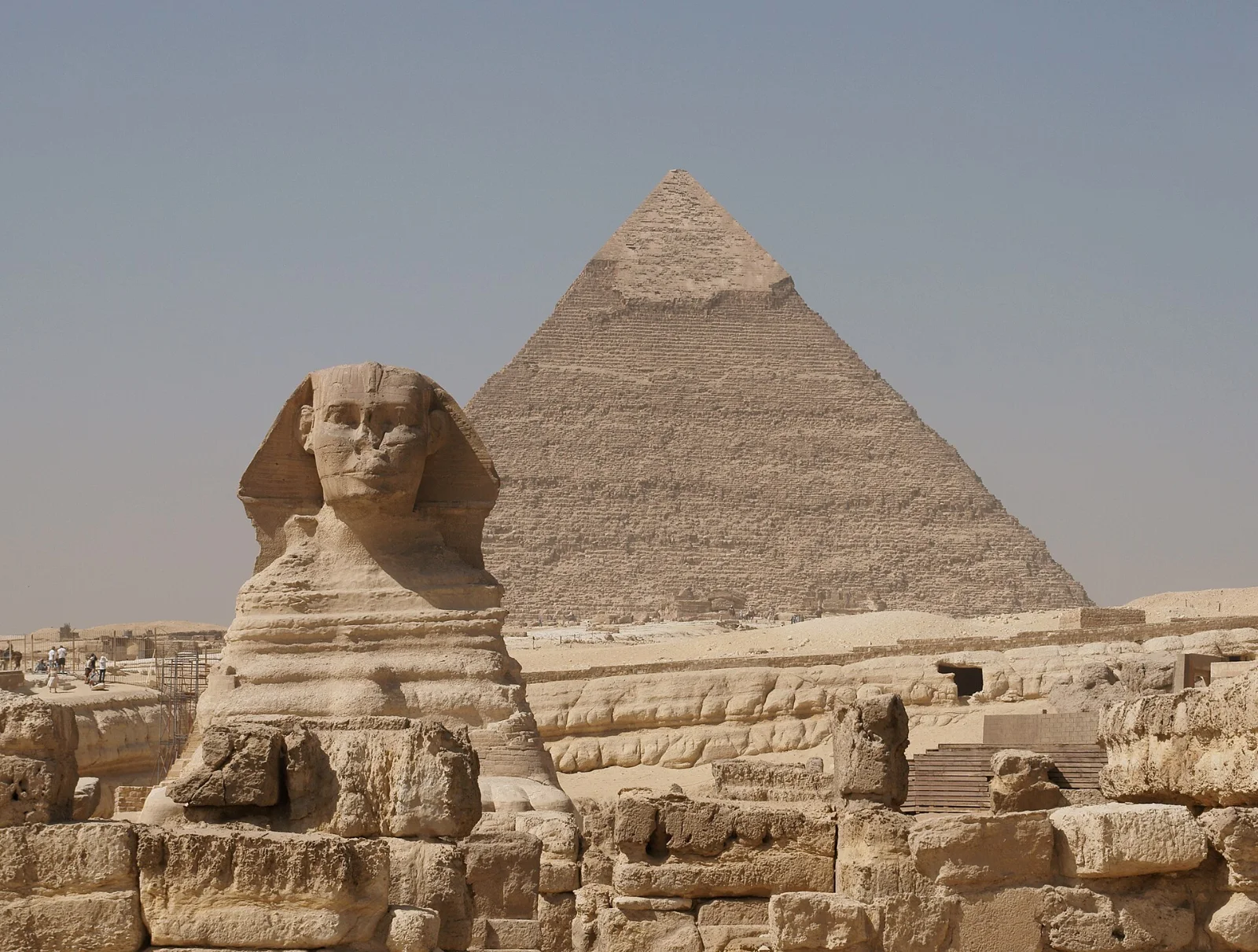
The nose was gone long before Napoleon arrived in 1798. A drawing by the Danish traveler Frederic Norden, published in the 1750s, already shows the Sphinx without it. The 15th-century Egyptian historian al-Maqrizi wrote that a Sufi named Muhammad Sa’im al-Dahr damaged the face in 1378. Chisel marks suggest the nose was deliberately pried off.
Read more: the Sphinx and the secret life of stone
Water erosion proves the Sphinx is over 10,000 years old
Disputed
In the early 1990s, geologist Robert Schoch argued that the deep weathering on the Sphinx enclosure was caused by heavy rainfall thousands of years before the pharaohs. Most geologists and Egyptologists disagree. They point to other causes, such as salt crystallization and the soft layers of the rock, and to the Sphinx’s clear connection with Khafre’s pyramid complex.
Tutankhamun’s tomb carried a deadly curse
False
Lord Carnarvon, who funded the excavation, died in 1923 from an infected mosquito bite, and newspapers invented the curse story. Howard Carter, who opened the tomb, lived until 1939. A 2002 study in the BMJ compared people present at the opening with those who were not and found no difference in how long they lived.
Ancient technology and “impossible” artifacts
The Antikythera mechanism is an ancient computer
True
Recovered from a shipwreck off the Greek island of Antikythera in 1901, this bronze device from the second or first century BC used dozens of interlocking gears to model the movements of the Sun, Moon and probably planets, and to predict eclipses. It is rightly called the world’s oldest known analog computer. Nothing as complex is known again for more than a thousand years.
The “Baghdad Battery” was an ancient electric battery
Unproven
The clay jars, found near Baghdad in the 1930s and dating from the Parthian or Sasanian period, contain a copper cylinder and an iron rod. Filled with an acid, a replica can produce a weak current. But no wires, conductors or electroplated objects have been found with them, and similar jars were used to store sacred scrolls. Most archaeologists think that is what they were.
Read more: the Baghdad Battery debate
The Dendera reliefs show ancient Egyptian light bulbs
False
The carvings in the Temple of Hathor at Dendera show a snake emerging from a lotus flower, a well-known Egyptian creation image. The texts around them describe religious rituals, not technology. No wiring, glass bulbs or other electrical equipment has ever been found in Egypt.
Read more: electricity in ancient times: facts and speculation
Elongated skulls are proof of aliens
False
Elongated skulls have been found in Peru, Europe, Africa and Asia. They are the result of artificial cranial deformation, the practice of binding a baby’s head with cloth or boards so that it grows into a long shape. It was often a mark of status or identity. Claims that DNA tests show non-human origins have never been published in a peer-reviewed journal.
Read more: the mysterious ancient elongated skulls
The Piri Reis map shows Antarctica without ice
False
The 1513 map by Ottoman admiral Piri Reis is a genuinely important early map of the Americas. In the 1960s Charles Hapgood argued that its southern coast showed Antarctica as it looked before the ice. Historians of cartography say it shows the coast of South America, bent eastward to fit the parchment, as on many maps of the time.
Read more: the most controversial map in history
Lost worlds and prehistoric monuments
Göbekli Tepe is about 6,000 years older than Stonehenge
True
Göbekli Tepe’s stone enclosures in southeastern Turkey date from around 9500 BC. Stonehenge began around 3100 BC. Göbekli Tepe was built by hunter-gatherers, before farming had taken hold, which changed how archaeologists think civilization began.
Read more: what Göbekli Tepe changed about civilization
Stonehenge was built by the Druids
False
The Druids were priests of Iron Age Britain and Gaul, described by Roman writers in the first century BC. Stonehenge was begun around 3100 BC and its great sarsen circle was raised around 2500 BC, about two thousand years before the Druids. The connection was invented by 17th- and 18th-century antiquarians such as John Aubrey and William Stukeley.
Read more: why Stonehenge was built
The Nazca Lines were runways for alien spacecraft
False
The Nazca culture of southern Peru made the lines and figures between about 500 BC and AD 500 by removing the reddish surface stones to reveal the pale ground underneath. The idea that they were runways was popularized by Erich von Däniken in 1968. The German mathematician Maria Reiche, who studied the lines for decades, pointed out that the soft ground would never have supported a landing. Most researchers link them to water, rituals and processions.
Read more: the desert lines that only make sense from the sky
Atlantis was a real place
Unproven
Every story about Atlantis goes back to one source: two dialogues written by the Greek philosopher Plato around 360 BC, which present it as a moral fable about a proud power punished by the gods. No independent ancient source mentions it, and no archaeological site matches it. The eruption of Thera (Santorini) and the decline of the Minoan civilization may have inspired parts of the story.
Read more: Edgar Cayce’s vision of Atlantis
The Easter Island heads have hidden bodies
True
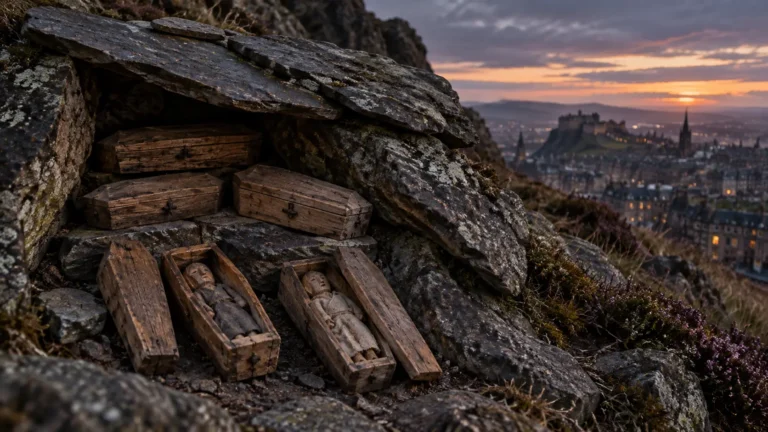
The famous “heads” on the slopes of the Rano Raraku quarry are full statues, buried up to their shoulders or chests over centuries by sediment washing down the hill. Excavations by the Easter Island Statue Project have uncovered their torsos, some carved with designs. The moai standing on platforms elsewhere on the island have always had visible bodies.
The Maya predicted the world would end in 2012
False
21 December 2012 marked the end of a large cycle in the Maya Long Count calendar, the 13th b’ak’tun, much like an odometer rolling over. Maya inscriptions do not describe it as the end of the world, and one text at Palenque refers to a date in AD 4772. The doomsday story was a modern invention.
Read more: the ancient calendars that predicted the end of the world
The Great Wall of China is visible from space with the naked eye
False
It cannot be seen from the Moon, and it is very difficult to see even from low Earth orbit. The wall is narrow and made of materials that blend into the landscape. China’s first astronaut, Yang Liwei, said in 2003 that he could not see it. Astronauts have photographed it from orbit, but only with zoom lenses or in perfect conditions.
Greeks, Romans and Vikings
The Library of Alexandria was destroyed in a single fire
False
The library declined over several centuries. The scholars’ expulsion in 145 BC, Caesar’s fire in 48 BC, the Roman wars of the AD 270s and the destruction of the Serapeum in 391 all played a part. The story that Arab conquerors burned it in AD 642 appears only centuries later and is regarded as fiction.
Read more: what really happened to the Library of Alexandria
Ancient people believed the Earth was flat
False
Educated Greeks knew the Earth was round by the fourth century BC. Aristotle pointed to the curved shadow of the Earth on the Moon during eclipses. Around 240 BC Eratosthenes measured the planet’s circumference with surprising accuracy. Medieval European scholars also knew it was a sphere.
Cleopatra was Egyptian
Partly true
Cleopatra VII ruled Egypt and was born in Alexandria, but she belonged to the Ptolemaic dynasty, descended from one of Alexander the Great’s Macedonian generals. According to Plutarch, she was the first of her dynasty to learn the Egyptian language. The identity of her mother is uncertain, so her full ancestry is still debated.
Read more: five myths about Cleopatra
Vikings wore horned helmets
False
No horned Viking helmet has ever been found. The only nearly complete Viking Age helmet, from Gjermundbu in Norway, is a simple rounded iron cap. Horns were attached to the Vikings by 19th-century artists, especially costume designer Carl Emil Doepler for the first full staging of Wagner’s Ring cycle in 1876. Some much older Bronze Age ceremonial helmets in Scandinavia did have horns.
Ancient Greek and Roman statues were pure white marble
False
Most were brightly painted. Traces of pigment survive on many sculptures and buildings, and researchers have used ultraviolet light and chemical analysis to reconstruct their original colors. The pure white look was admired by Renaissance and later artists who only saw the weathered marble.
Gladiators always fought to the death
False
Gladiators were expensive to train and keep, and most fights did not end in death. Bouts had referees and rules, and a defeated fighter could appeal for release. Studies of epitaphs and records suggest death rates rose in the later empire, but even then a gladiator often fought several times.
Read more: the Roman Colosseum
Romans had a vomitorium to throw up during feasts
False
A vomitorium was a passageway in an amphitheater or stadium that let crowds “spew out” quickly at the end of a show. The fifth-century writer Macrobius used the word this way. The idea that it was a room for vomiting during banquets is a 20th-century misunderstanding.
Sources8
- Nelson, M. R. (2002). The mummy’s curse: historical cohort study. BMJ
- Easter Island Statue Project
- NASA: China’s Wall Less Great in View from Space
- Britannica: The fate of the Library of Alexandria
- UNESCO: Göbekli Tepe
- UNESCO: Lines and Geoglyphs of Nasca and Palpa
- Britannica: Antikythera mechanism
- Diary of Merer